
Are You EPR-Ready? A Practical Checklist for Packaging Teams Operating in the US

What does EPR-ready mean for a packaging team?
An EPR-ready packaging team has completed four things: confirmed their Producer status under each relevant US state EPR law; built a centralised packaging data system capable of reporting SKU-level material weights, recycled content, and recyclability; assessed their exposure to California SB 343 labelling requirements effective 2026; and modelled their fee obligations under state fee structures including eco-modulated systems. EPR readiness is not a compliance exercise, it is an operational infrastructure question.
The Question Every US-Facing Brand Must Answer Now
Seven US states have passed packaging EPR legislation. Ten more introduced bills in 2025. The first fee payment deadlines, Oregon and Colorado, have already landed. California's SB 343 labelling requirements take effect October 2026. AB 660 date labelling standardisation is live from July 2026.
The brands that are struggling are not the ones that decided not to comply. They are the ones that assumed EPR either did not apply to them, or that it was a sustainability team problem rather than a packaging operations problem. Both assumptions are wrong.
This checklist is built from Packfora's EPR advisory work across the US market. It covers five areas every packaging team needs to have locked before their first active state deadline arrives: Producer status, data infrastructure, state-by-state exposure, California-specific requirements, and fee strategy.

Checklist Section 1: Confirm Your Producer Status
The most common misunderstanding in EPR compliance is assuming Producer status only applies to packaging manufacturers. It does not. Under US EPR laws, Producer status is assigned to the entity that places packaged goods on the market, not the entity that makes the packaging.
| Business Model | Scenario | EPR Status |
|---|---|---|
| Domestic brand-owner | Your brand appears on the packaging | You are the Producer |
| Imported products | Your brand enters the state market | You are the Producer, importers assume full EPR obligations |
| Supplier-owned packaging | Shared commercialisation control | Shared responsibility, varies by state definition |
| Private-label / DTC | You specify or approve packaging used by suppliers | You are the Producer |
You are classified as a Producer if you do any of the following:
- Sell or import products under your own brand name
- Use packaging that carries your trademark or logo
- Supply private-label or direct-to-consumer products
- Specify or approve packaging used by your suppliers
Producer Status Checklist
- Confirm brand ownership scope: Have you identified every brand, sub-brand, and private-label line that places packaged goods on US state markets?
- Map import obligations: For every product imported into EPR states, has your team confirmed that you as importer bear full Producer responsibility, regardless of where the packaging was manufactured?
- Audit supplier-owned packaging: Where your supplier's packaging carries a shared logo or brand reference, have you assessed whether shared responsibility applies under each state's definition?
- Register with state PROs: Have you initiated producer registration with the Producer Responsibility Organisations (PROs) in Wave 1 states (Oregon, Colorado) where deadlines have already passed?
Checklist Section 2: Build Your Packaging Data Engine
Data is the single biggest operational bottleneck in EPR compliance. Every state requires component-level packaging data, material weights, recycled content percentages, PCR content by component, and SKU-level traceability. Without a centralized data architecture, multi-state reporting is not scalable.
Packfora's EPR advisory position on this is unambiguous: the data infrastructure question must be resolved before the compliance calendar question. Brands that attempt to build state-by-state reporting without a central data layer will face exponentially increasing complexity as more states activate.
Data Infrastructure Checklist
- Central packaging data engine: Do you have a single source of truth for all packaging specifications, material type, weight per component, recycled content %, PCR source, and recyclability status, across your entire SKU portfolio?
- SKU-to-state sales mapping: Can you report, by SKU, the volume of packaged goods placed on the market in each EPR state? This is the basis for fee calculation in every state framework.
- Recyclability validation: Have you validated the recyclability status of each packaging component against the specific definitions used by each active state, not generic recyclability claims?
- Multi-state reporting capability: Is your data system structured to output reports in the format required by each state PRO, or are you still relying on manual extraction?
- LCA documentation: Do you have Lifecycle Assessments completed for your highest-volume SKUs? Oregon's Bonus A programme offers up to $20K per SKU in fee credits for ISO-compliant LCA disclosure.
Checklist Section 3: Map Your State-by-State Exposure
There is no national EPR standard. Each state defines Producer, covered packaging formats, fee structures, and recyclability differently. Managing this as a single compliance programme will produce errors, the correct approach is a wave-based roadmap with state-specific governance.
| State | Wave | Deadline | Coverage | Most Exposed |
|---|---|---|---|---|
| Oregon (SB 582) | Wave 1 | Jul 2025 | Packaging, Paper, Food Serviceware (partial) | CPG Brands, Retailers, Food Service |
| Colorado (HB 1355) | Wave 1 | Jul 2025 | Packaging, Paper Products | Consumer Brands, Residential Channels |
| Maine (LD 1541) | Wave 2 | 2026–27 | Packaging (full coverage) | Brands with High Municipal Footprint |
| California (SB 54) | Wave 2 | Jan 2027 | Packaging + Plastic Food Serviceware | Large National, Private Label, QSR |
| Washington (SB 5284) | Wave 3 | 2028–29 | Packaging, Paper Products | Brands with West Coast Exposure |
| Maryland (SB 901) | Wave 3 | 2029 | Packaging, Paper Products | East Coast Brands, Grocery, CPG |
| Minnesota (HF 3911) | Wave 3 | 2030–32 | Packaging, Paper, Food Packaging | Mid-to-Large Brands, Omnichannel Sellers |
State Exposure Checklist
- Wave 1 active (Oregon, Colorado, Jul 2025): If you sell into these states, producer registration and fee payment obligations are already live. Have you registered and filed?
- Wave 2 preparation (Maine 2026–27, California Jan 2027): California SB 54 is the most demanding framework, broad coverage, strict recyclability definitions, SB 343 labelling overlay. Is your California compliance plan built?
- Wave 3 horizon planning (Washington 2028–29, Maryland 2029, Minnesota 2030–32): These states are not distant, the data infrastructure you build now must be designed to accommodate them without rebuild.
- B2B exemption audit: Some states (Colorado, Washington) exclude B2B packaging from fee obligations. Have you confirmed which of your packaging volumes qualify for exemption under each state's specific definition?
- Multi-state governance model: Have you established a dedicated internal team or process, Finance, Procurement, and Sustainability aligned, to manage varying state obligations as they activate?
Checklist Section 4: California 2026, SB 343 and AB 660
California is the most complex EPR state and the one with the most immediate labelling risk. Two laws take effect in 2026 that go beyond fee obligations, they govern what you are permitted to print on your packaging. Brands that miss these requirements face fines, shelf removal, and greenwashing exposure.
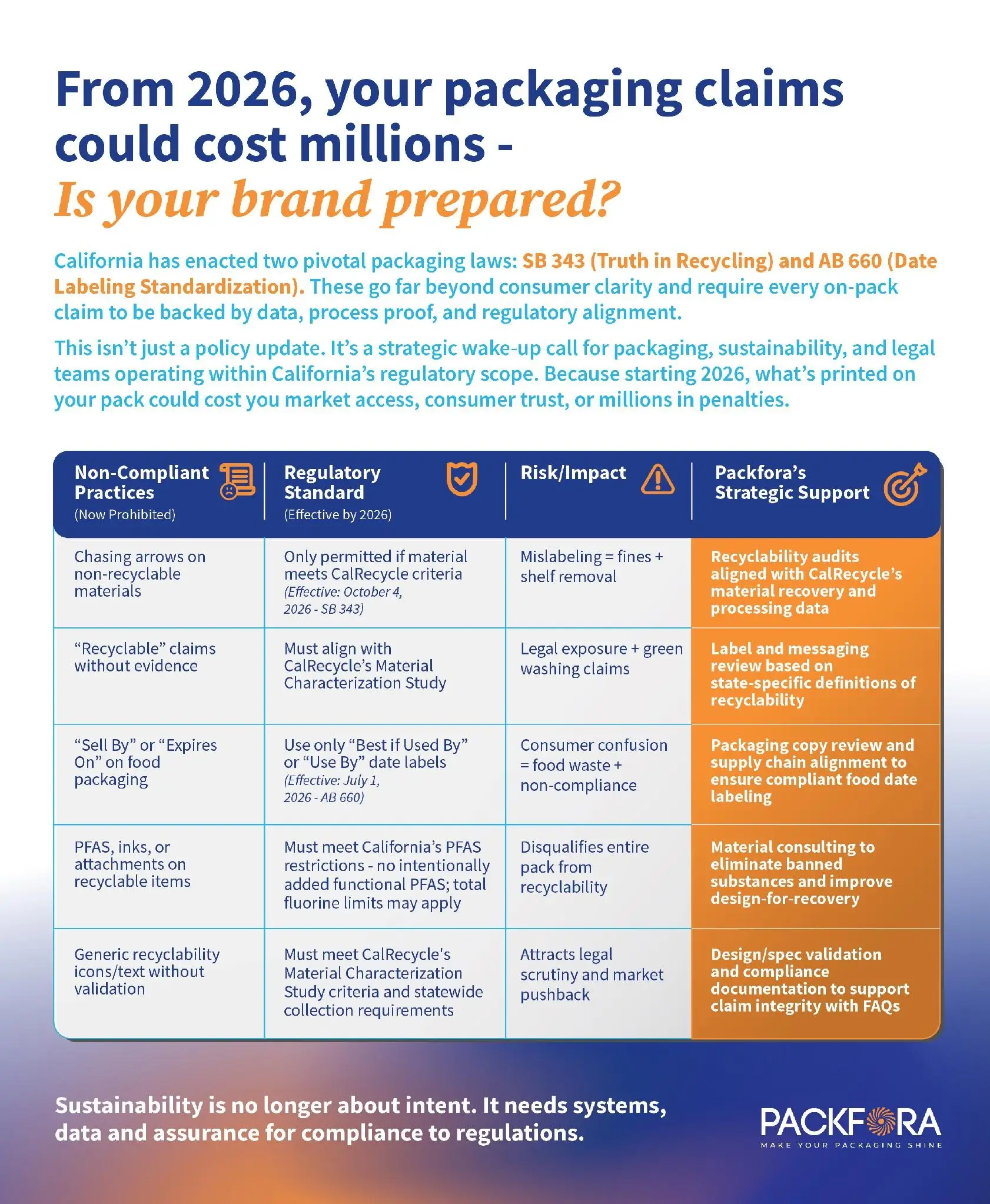
| Non-Compliant Practice | Regulatory Standard (Effective 2026) | Risk / Impact | Packfora's Strategic Support |
|---|---|---|---|
| Chasing arrows on non-recyclable materials | Only permitted if material meets CalRecycle criteria (SB 343, effective Oct 4, 2026) | Mislabelling = fines + shelf removal | Recyclability audits aligned with CalRecycle's material recovery and processing data |
| 'Recyclable' claims without evidence | Must align with CalRecycle's Material Characterisation Study | Legal exposure + greenwashing claims | Label and messaging review based on state-specific recyclability definitions |
| 'Sell By' or 'Expires On' on food packaging | Use only 'Best if Used By' or 'Use By' (AB 660, effective Jul 1, 2026) | Consumer confusion = food waste + non-compliance | Packaging copy review and supply chain alignment for compliant date labelling |
| PFAS, inks, or attachments on recyclable items | Must meet California PFAS restrictions, no intentionally added functional PFAS | Disqualifies entire pack from recyclability | Material consulting to eliminate banned substances and improve design-for-recovery |
| Generic recyclability icons without validation | Must meet CalRecycle Material Characterisation Study and statewide collection requirements | Legal scrutiny and market pushback | Design/spec validation and compliance documentation |
California Compliance Checklist
- Recyclability claims audit (SB 343, effective Oct 4, 2026): Have you audited every recyclability claim on every pack sold in California against CalRecycle's Material Characterisation Study? Generic chasing arrows on non-recyclable materials are now prohibited.
- Food date labelling standardisation (AB 660, effective Jul 1, 2026): Have you replaced all 'Sell By' and 'Expires On' date labels on food packaging with 'Best if Used By' or 'Use By' in line with the new standard?
- PFAS audit: Have you confirmed that no intentionally added functional PFAS are present in inks, coatings, or attachments on packaging classified as recyclable in California?
- CalRecycle criteria validation: Have you verified that each packaging format you claim as recyclable meets CalRecycle's statewide collection and processing requirements, not just general recycling infrastructure?
Checklist Section 5: Fee Strategy and the LCA Opportunity
EPR fee structures are not static. The Circular Action Alliance (CAA), which leads EPR programme design across US states, is driving a shift from simple weight-based fee models towards eco-modulated fees based on Lifecycle Assessment (LCA) data. California and Colorado are expected to follow Oregon's lead.
This changes the fee calculation fundamentally: packaging choices directly determine compliance costs. A format with a lower environmental impact score, demonstrated through a credible LCA, will attract lower fees. LCA data is no longer an ESG metric. It is a financial lever.
Oregon Bonus A, Fee Credit Opportunity
Oregon is the first US EPR programme to reward LCA transparency. Brands that disclose a Lifecycle Assessment qualify for:
- 10% fee credit, up to $20,000 per SKU
- Applies to ISO-compliant, third-party reviewed LCAs
- Resubmissions allowed for up to 24 months
LCAs are no longer ESG checkboxes. They are financial levers.
Fee Strategy Checklist
- Material-level fee modelling: Have you modelled your EPR fee exposure by material type and state, under both current weight-based and emerging eco-modulated frameworks?
- Oregon LCA Bonus A: Have you assessed whether your Oregon-registered SKUs qualify for the 10% fee credit (up to $20K/SKU) available for ISO-compliant LCA disclosure? Resubmissions are allowed for up to 24 months.
- Design-for-lower-fees: Are your packaging design briefs incorporating EPR fee modulation criteria, recyclability, recycled content, material weight, as commercial design inputs alongside cost and performance?
- Fee trajectory modelling: Have you built a 3–5 year fee cost model that incorporates likely eco-modulation adoption across your active state portfolio? The cost gap between compliant and non-compliant packaging will widen.
Packfora's sustainability consulting helps brands translate EPR obligations into packaging material and design strategy, building the compliance infrastructure that fee modulation and multi-state reporting demand.
For packaging teams ready to build a Design-for-EPR specification, where recyclability, material choices, and fee exposure are engineered into the pack from the brief stage, Packfora's Design to Value service connects compliance requirements directly to structural and material design decisions.
Frequently Asked Questions
How do I know if my company is classified as a Producer under US EPR laws?
You are classified as a Producer if you sell or import products under your own brand name, use packaging carrying your trademark or logo, supply private-label or direct-to-consumer products, or specify/approve the packaging used by your suppliers. Critically, Producer status follows who places the product on the market, not who manufactures the packaging. Importers assume full EPR Producer obligations for foreign-made goods entering EPR states, regardless of where the packaging was produced.
What data do I need to report under US state EPR laws?
All active US state EPR programmes require component-level packaging data: material type by component, weight per component, post-consumer recycled (PCR) content percentage, recyclability status validated against state-specific definitions, and SKU-level sales volumes by state. Because each state uses different definitions of recyclability and different fee calculation methods, a centralised packaging data architecture, rather than state-by-state manual reporting, is the only scalable approach for multi-state producers.
What does California SB 343 require and when does it take effect?
SB 343 (Truth in Recycling) takes effect October 4, 2026, and prohibits recyclability claims on packaging that does not meet CalRecycle's Material Characterisation Study criteria and statewide collection standards. This means chasing arrows, 'recyclable' text, and generic recycling icons are no longer permissible unless the specific packaging material is validated as recyclable under California's framework. The accompanying AB 660 (Date Labelling Standardisation) takes effect July 1, 2026, standardising food date labels to 'Best if Used By' or 'Use By', replacing 'Sell By' and 'Expires On' language.
What is eco-modulated EPR fee pricing and how does it affect packaging decisions?
Eco-modulated EPR fees adjust the per-tonne fee a Producer pays based on the environmental performance of their packaging, typically measured through recyclability rates, recycled content, material weight, and increasingly, Lifecycle Assessment (LCA) scores. Oregon is the first US EPR programme to implement eco-modulation, offering a 10% fee credit (up to $20,000 per SKU) for brands that disclose ISO-compliant, third-party reviewed LCAs. California and Colorado are expected to adopt similar eco-modulation frameworks. The practical implication is that packaging design choices directly determine compliance costs, making LCA data a financial lever, not just an ESG reporting tool.
This is Post 2 of 5 in the Packfora EPR series. Post 1: EPR Revolution, How Turning Compliance into Competitiveness Gives Brands an Edge


