
Can Redesigning Vent Holes Transform Packaging Performance? A 13kg Banana Box Study

What is Finite Element Analysis (FEA) in packaging?
Finite Element Analysis (FEA) is a computer-based simulation method that models how a structure - such as a corrugated box - responds to physical forces like compression, stacking load, and stress concentration. In packaging design, FEA allows engineers to test multiple structural variants digitally before committing to physical prototypes, identifying failure points and optimising design with precision and zero additional material cost.
When the Problem Isn't the Material - It's the Shape
Most packaging redesigns start with the obvious: change the material, increase the board grade, add reinforcement. But what if the issue wasn't what the box was made of - but how it was designed?
That's exactly the question Packfora set out to answer with a standard 13kg banana box - one of the most structurally demanding formats in fresh produce packaging. The result was a measurable performance leap achieved through a single design insight, at zero additional cost.

The Challenge: A Box Under Pressure
Banana boxes are a particularly unforgiving test of structural packaging. They must survive stacked refrigerated transit, maintain structural integrity under significant load, and simultaneously allow adequate airflow to manage fruit ripening - two performance requirements that are inherently in tension.
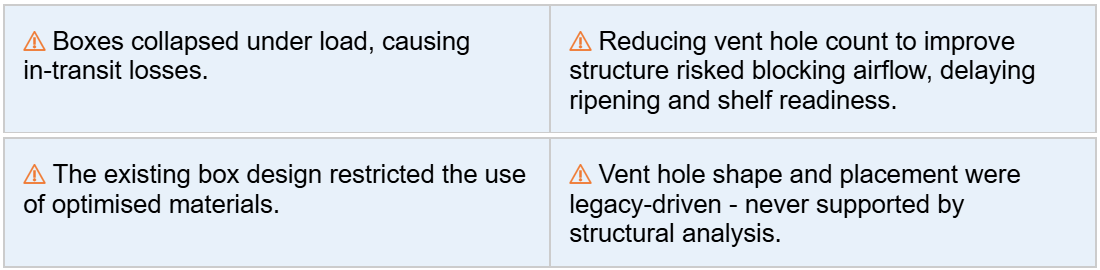
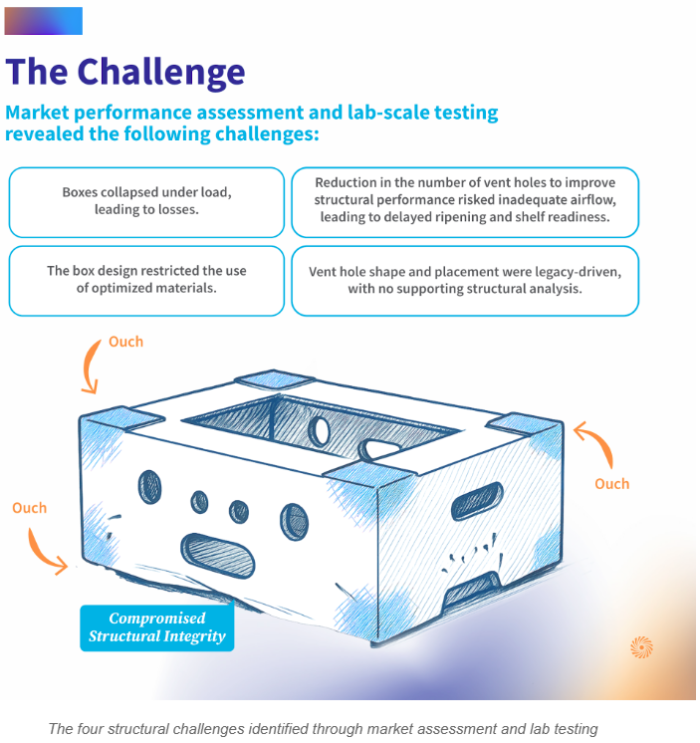
Market performance assessment and lab-scale testing on the existing design revealed four compounding problems:
The Design Insight: Shape and Placement Over Material
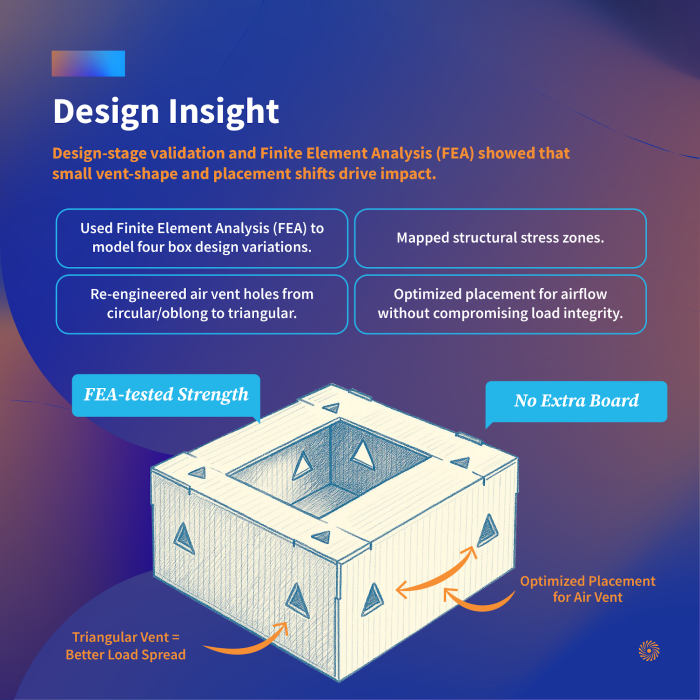
Rather than defaulting to heavier board or additional reinforcement, Packfora's team applied design-stage validation and Finite Element Analysis (FEA) - modelling four distinct box design variations to map structural stress zones across the entire packaging surface.
The key finding: the problem wasn't the number of vent holes. It was their shape and where they sat on the box.
Circular and oblong vent holes - the legacy standard - concentrate stress at their edges under compression load. By re-engineering the vents from circular/oblong to triangular, and strategically repositioning them for optimal airflow, the stress distribution across the box changed fundamentally.
| Design Action | What It Achieved |
|---|---|
| FEA modelling of 4 box variants | Identified exact stress concentration zones - no guesswork |
| Circular → Triangular vent shape | Better load distribution - compression strength up 10% |
| Optimised vent placement | Top vent area up 17% - ripening and shelf readiness resolved |
The Results: Zero Added Cost, 100% Smarter Design
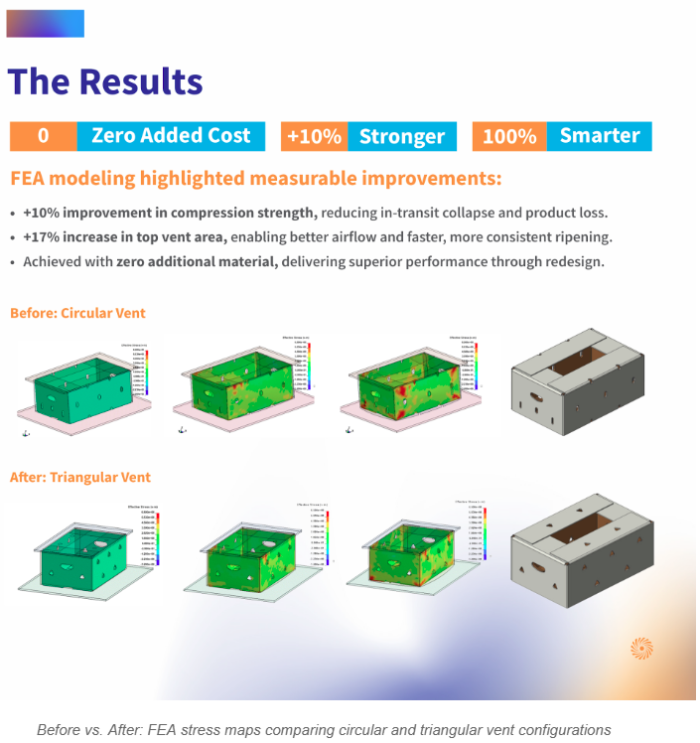
FEA modelling confirmed the gains before a single physical prototype was committed to. The outcome speaks for itself:
- +10% improvement in compression strength
- +17% increase in top vent area
- Zero additional material used
- Both structural integrity and airflow requirements fully met
This is the defining principle of value engineering in packaging: performance improvement through design intelligence, not material spend.
| Metric | Before (Circular Vent) | After (Triangular Vent) |
|---|---|---|
| Vent Shape | Circular / Oblong | Triangular |
| Compression Strength | Baseline | +10% improvement |
| Top Vent Area | Baseline | +17% increase |
| Additional Material Used | N/A | Zero |
| Structural Analysis | Legacy-driven, no FEA | FEA-validated (4 variants) |
| Ripening / Airflow Risk | High - tradeoff | Resolved - both optimised |
Why This Matters Beyond Banana Boxes
The vent hole redesign is not a produce industry story - it's a structural packaging principle with broad application. Any corrugated format where:
...can benefit from the same FEA-led approach. The gains scale with the volume: a 10% improvement in compression strength across a high-volume SKU compounds into significant reductions in transit damage claims, product loss, and customer returns.
Packfora's Design to Value service applies exactly this methodology - combining structural science, simulation, and commercial awareness to find performance gains without cost escalation.
The Packfora Approach: Simulation-Led, Commercially Grounded
The banana box case study demonstrates what becomes possible when structural design is treated as an engineering discipline rather than a cost variable. Packfora's methodology combines:
The question for any brand carrying significant packaging volume is not whether FEA-led redesign is worth it. It's how much performance has already been left on the table.
Explore Packfora's structural packaging consultancy to understand what a simulation-led review could uncover in your current packaging formats.
For procurement teams managing corrugated packaging at scale, Packfora's packaging procurement support brings the same rigour to supplier specifications and material selection.
Frequently Asked Questions
What is Finite Element Analysis (FEA) and how is it used in packaging design?
FEA is a computational simulation technique that models how a structure responds to physical forces - compression, stacking load, internal stress - by breaking it into thousands of small elements and calculating behaviour across each. In packaging design, FEA allows structural variants to be tested digitally before prototyping, identifying optimal shapes and configurations with precision. Packfora used FEA to model four banana box variants, pinpointing how vent shape and placement directly affected compression performance.
Why did changing vent holes from circular to triangular improve structural performance?
Circular and oblong vent holes create stress concentration at their curved edges when load is applied - the geometry distributes force unevenly. Triangular vents distribute compression load more efficiently across the structure, reducing peak stress at any single point. Combined with strategic placement optimised through FEA, this delivered a 10% compression strength improvement without adding material.
Can FEA-led packaging redesign be applied to formats beyond corrugated produce boxes?
Yes. Any packaging format where structural integrity is a performance variable can benefit from FEA-led design: secondary packaging, transit packaging, retail-ready displays, and high-volume consumer goods cartons. The methodology is especially high-value where ventilation and load-bearing are in tension, or where legacy designs have never been validated against current performance requirements.
How does Packfora's Design to Value approach differ from standard packaging engineering?
Standard packaging engineering typically optimises for a single variable - usually cost or material use. Packfora's Design to Value methodology models structural, airflow, and commercial performance simultaneously, using simulation to find configurations that improve on all three without trade-offs. The banana box study is a direct example: both compression strength and vent area improved, at zero additional material cost.
- ventilation and load-bearing are in tension,
- legacy design assumptions have never been stress-tested, or
- material cost reduction is a business priority,
- Design-stage FEA validation before physical prototyping
- Structural stress mapping across multiple design variants
- Airflow and load performance modelled simultaneously - not as competing constraints
- Zero-cost performance improvement as the design brief, not the exception


