
Packforum 2024 Insights: Next-Gen Recycling & Materials: What Packaging Teams Need to Know Now

What is advanced recycling in packaging?
Advanced recycling refers to technologies that go beyond conventional mechanical recycling to recover value from packaging materials that cannot be processed through standard sorting and reprocessing systems. This includes chemical recycling (breaking polymers down to monomer level), solvent-based recycling (selectively dissolving specific polymers from complex waste streams), and enzymatic/biological methods. Advanced recycling is particularly significant for multi-layer laminates, flexible plastics, and materials that degrade in quality through mechanical reprocessing.
The Material Transition Is Not Coming. It Is Here.
There is one, and only one route to packaging solutions that genuinely align with regulatory requirements and shifting consumer expectations: new recycling technologies and new materials. The question for packaging teams is no longer whether to engage with next-generation materials, it is how to do so strategically, at pace, without compromising commercial performance.
Packforum 2024 brought together packaging and sustainability leaders representing a combined packaging spend of $30 billion to address exactly this challenge. The material innovation picture that emerged was expansive, chemical recycling, seaweed-based formats, bamboo injection moulding, Bio-PET, non-polymer coatings for paper, and smart packaging for food freshness detection, and equally demanding in terms of the critical evaluation required to convert possibility into viable specification.

Beyond Mechanical: The Recycling Technologies Reshaping What's Possible
Mechanical recycling, the sorting, shredding, and reprocessing of polymers, remains the backbone of packaging recovery systems globally. But it has a structural ceiling: it cannot effectively process multi-layer laminates, heavily contaminated streams, or materials that degrade in quality through repeated processing cycles.
Advanced recycling methodologies address this ceiling. Packforum 2024 surfaced several approaches that packaging teams need to understand, not as distant R&D projects, but as active investment areas with practical implications for specification decisions being made now.
| Recycling Method | How It Works | Key Challenge |
|---|---|---|
| Mechanical recycling | Shreds and reprocesses polymers into new material. Most established method. | Limited by contamination, material degradation over cycles, and inability to process multi-layer laminates. |
| Chemical recycling | Breaks polymers down to monomer level using heat or solvents; material can be rebuilt to virgin quality. | Energy-intensive; cost premium over mechanical; scaling infrastructure still developing. |
| Solvent-based recycling | Uses selective solvents to dissolve and recover specific polymers from complex waste streams. | Highly selective; works where mechanical methods fail. Limited polymer range; solvent recovery required. |
| Biological / enzymatic | Enzymes break down specific polymers (e.g. PET). Early-stage but growing investment. | Limited to specific material types; currently pre-commercial at scale. |
The strategic implication is that packaging designs which are currently non-recyclable through mechanical systems are not permanently so. Chemical and solvent-based routes are creating new end-of-life pathways. Brands investing in design-for-circularity now, structuring packaging to be compatible with emerging advanced recycling infrastructure, will be better positioned when those pathways scale commercially.
The challenge, as Packforum discussions made clear, is that packaging companies must simultaneously evaluate what they are able to create cost-efficiently, what suits specific product categories, and whether proposed solutions can be sustained in the long run. The scope is overwhelming when approached without a framework, which is why strategic evaluation, not material substitution by default, is the correct starting posture.
The New Material Landscape: From Seaweed to Bio-PET
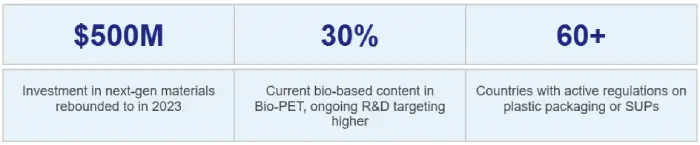
Investment in next-generation materials rebounded to $500 million in 2023, signalling renewed commercial confidence after a period of cautious pullback. The materials landscape discussed at Packforum 2024 spans a wide range, from formats already in commercial deployment to those still navigating scale-up challenges:
| Material / Technology | Application | Key Benefit | Current Limitation |
|---|---|---|---|
| Seaweed / Notpla | Edible pods, sachets | Biodegrades in weeks; edible; marine-safe | Limited to small formats; production scale constrained |
| Bamboo injection moulded | Rigid packaging, trays, containers | Naturally renewable; strong; compostable | Performance vs conventional plastics still maturing |
| Bio-PET | Bottles, films, trays | Same properties as petroleum PET; fully recyclable | Only ~30% bio-based currently; not fully renewable yet |
| Chemical recycling | All polymer types | Breaks down non-mechanically recyclable plastics | Energy-intensive; scaling challenges; cost premium |
| Non-polymer coatings | Paper and board packaging | Replaces plastic laminate; improves recyclability | Barrier performance gaps vs plastic laminates |
| Smart freshness sensors | Food & Bev primary pack | Reduces food waste; extends shelf life management | Cost premium; consumer education required |
Seaweed-Based Packaging: Notpla and the Biodegradability Advantage
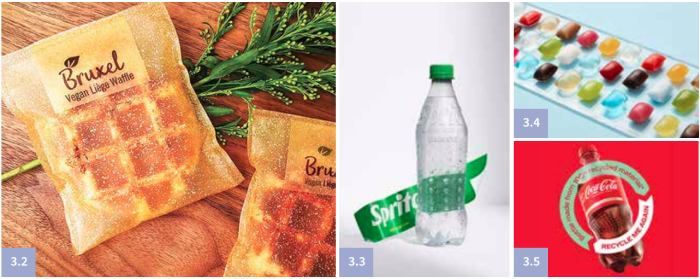
The most striking material example surfaced at Packforum 2024 is Notpla, a brand that has introduced seaweed-based gel pods as a genuinely multi-pathway biodegradable format. The Notpla solution addresses a problem that conventional biodegradable claims do not: what happens when the packaging is not disposed of correctly?
Notpla's pods are biodegradable at three levels: if consumed through eating, they pose no environmental risk; if discarded on land, they naturally break down within weeks; if disposed of in the sea, they act as food for marine organisms rather than pollutant. This addresses the systemic failure point of most biodegradable packaging, that it requires specific infrastructure to realise its end-of-life benefit.
Current limitation: Notpla's format is constrained to small-volume applications, event sachets, condiment pods, beverage portions. The question for larger format applications remains open.
Bio-PET: The Recyclability-Compatible Renewable Option
Bio-PET (Bio-based Polyethylene Terephthalate) represents a different material strategy: not a departure from existing PET infrastructure, but a partial renewable substitution within it. Derived from sugarcane or corn, Bio-PET currently incorporates approximately 30% bio-based content while retaining identical properties to petroleum-based PET, durability, transparency, moisture resistance, and full compatibility with existing PET recycling streams.
The strategic appeal is clear: brands can improve their renewable content credentials without requiring consumers to change disposal behaviour or requiring recyclers to build new infrastructure. The constraint, that only 30% is currently bio-based, is acknowledged. Ongoing innovation is targeting higher bio-based proportions, but the commercial reality today is partial substitution, not full displacement of fossil-derived content.
Bamboo Injection Moulded Packaging: Performance Catching Up With Promise
Bamboo injection moulded packaging has attracted significant attention as a naturally renewable, rapidly regenerating alternative to petroleum-based rigid formats. Bamboo's structural properties, tensile strength, density, and natural antimicrobial characteristics, make it an attractive candidate for trays, containers, and secondary packaging.
The practical challenge is performance consistency at commercial scale. Bamboo-derived packaging materials are maturing in their performance comparison with conventional plastics, but the gap in dimensional stability, moisture resistance, and manufacturing repeatability means that adoption is currently concentrated in premium and purpose-led product categories rather than high-volume commodity formats.
Smart Packaging for Food Freshness: Reducing Waste Through Design
New technology in next-generation packaging is not limited to materials alone. In the Food & Beverage industry, smart packaging solutions that detect freshness indicators and temperature history are beginning to enter commercial deployment, and the commercial case is significant.
Food waste is a material cost problem as well as an environmental one. Packaging that communicates the actual freshness state of a product, rather than relying on fixed use-by dates that are necessarily conservative, reduces unnecessary waste of products that are still within safe consumption parameters. For brands carrying significant perishable SKUs, this translates directly into reduced returns, fewer disposal costs, and stronger consumer trust.
The technology levers at play include:
- Time-temperature indicators (TTIs), visual signals embedded in packaging that respond to thermal history
- Gas sensors, detecting spoilage gases (CO₂, ethylene, ammonia) within modified atmosphere packaging
- RFID and NFC freshness tags, enabling real-time shelf monitoring and automated restocking triggers
- Printed electronics, low-cost conductive inks enabling freshness sensing in flexible packaging formats
Packfora's Design to Value methodology integrates next-generation material evaluation directly into the packaging design process, assessing performance, cost, recyclability, and regulatory compliance simultaneously rather than as sequential stages.
The Expert View: Why Change Must Happen Now
Kory Nook, Vice-President (R&I) at Danone, spoke directly to the urgency at Packforum 2024. His framing was unambiguous:
"Change needs to happen NOW. Current practices are unsustainable and could harm businesses if not changed. Companies that lead in sustainable practices can gain an advantage, there is significant growth potential in sustainable products, with consumers increasingly driven by environmental and social concerns. This can be achieved through evaluating every step of the value chain from sourcing to end-of-life."
— Kory Nook, VP R&I, Danone, Packforum 2024
Nook's point on investor pressure is equally important for packaging teams to internalise: investors are increasingly prioritising decarbonisation and are critical of greenwashing. To attract capital, companies must set clear CO₂ reduction targets integrated into business strategy, not isolated in sustainability reporting. Packaging material choices are a visible, measurable, auditable component of that commitment.
The consumer dimension reinforces the urgency but adds a commercial constraint: consumers are becoming more sophisticated in their understanding of sustainability, while simultaneously showing unwillingness to pay premium prices for eco-friendly packaging. This means innovation must deliver both the environmental credential and the cost parity, which is precisely why strategic material selection, rather than default substitution, is the correct frame.
What This Means for Packaging Teams: A Three-Part Framework
| Evaluate strategically, not reactively New materials must be assessed against three simultaneous criteria: cost-efficiency at target volumes, suitability for the specific product category and safety requirements, and long-run sustainability, both environmental and commercial. |
Design for tomorrow's recycling infrastructure Advanced recycling pathways (chemical, solvent-based) are scaling. Packaging designed for compatibility with these systems now will have an extended viable lifecycle as infrastructure matures. |
Treat smart packaging as a waste-reduction lever Freshness-sensing packaging is not a premium feature, it is a food waste reduction tool with direct cost implications. Evaluate it against waste disposal costs, not just unit packaging cost. |
Brands ready to translate next-generation material insights into packaging specification decisions can explore Packfora's sustainability consulting, where material strategy, regulatory alignment, and commercial performance are evaluated together.
For teams working on packaging redesign that must balance new material adoption with structural performance, Packfora's structural packaging consultancy applies simulation-led validation to ensure performance is not compromised in the transition.
Frequently Asked Questions
What is chemical recycling and how does it differ from mechanical recycling?
Mechanical recycling shreds and reprocesses plastic materials, it is the most widely deployed method but is limited by contamination, material degradation over cycles, and inability to process multi-layer laminates. Chemical recycling breaks polymers down to their monomer building blocks using thermal or chemical processes, allowing the material to be rebuilt to near-virgin quality. This means chemical recycling can process materials that mechanical systems cannot, including contaminated streams and complex multi-material packaging. The trade-off is higher energy use and current cost premium over mechanical alternatives.
What is Bio-PET and is it better than regular PET?
Bio-PET (Bio-based Polyethylene Terephthalate) is a partially bio-based alternative to petroleum PET, currently incorporating approximately 30% content derived from renewable sources such as sugarcane or corn. It retains identical physical and chemical properties to conventional PET, including durability, clarity, and moisture resistance, and is fully compatible with existing PET recycling infrastructure. Its advantage over standard PET is a reduced fossil-derived carbon footprint. Its current limitation is that only ~30% of its composition is bio-based; ongoing innovation aims to increase this proportion.
Can seaweed-based packaging replace conventional plastic at scale?
Currently, seaweed-based packaging formats, most notably Notpla's gel pods, are commercially viable for small-format applications: event sachets, condiment portions, beverage pods. Their biodegradability advantage is genuine and multi-pathway, which distinguishes them from conventional 'biodegradable' materials that require specific infrastructure. Scaling to larger formats remains a production and material science challenge. The near-term opportunity is targeted adoption in high-visibility, high-waste-impact applications rather than wholesale replacement of conventional formats.
What is smart packaging for food freshness and how does it work?
Smart freshness packaging uses embedded sensors or indicators to communicate the actual condition of a perishable product rather than relying solely on fixed use-by dates. Technologies include time-temperature indicators (TTIs) that respond to thermal history, gas sensors detecting spoilage indicators within modified atmosphere packaging, and NFC or RFID tags enabling real-time shelf monitoring. The commercial case is food waste reduction: packaging that accurately signals whether a product is still safe and fresh reduces unnecessary disposal of products that are within consumption parameters, cutting waste costs for both brand and retailer.


